


Report Materials
Why OIG Did This Audit
- Under the Medicare Advantage (MA) program, CMS makes monthly payments to MA organizations according to a system of risk adjustment that depends on the demographic characteristics and health status of each enrollee. Accordingly, MA organizations are paid more for providing benefits to enrollees whose diagnoses are associated with more intensive use of health care resources relative to healthier enrollees, who would be expected to require fewer health care resources.
- To determine the health status of enrollees, CMS relies on MA organizations to collect diagnosis codes from their providers and submit these codes to CMS. Some diagnoses are at higher risk for miscoding, which may result in overpayments from CMS.
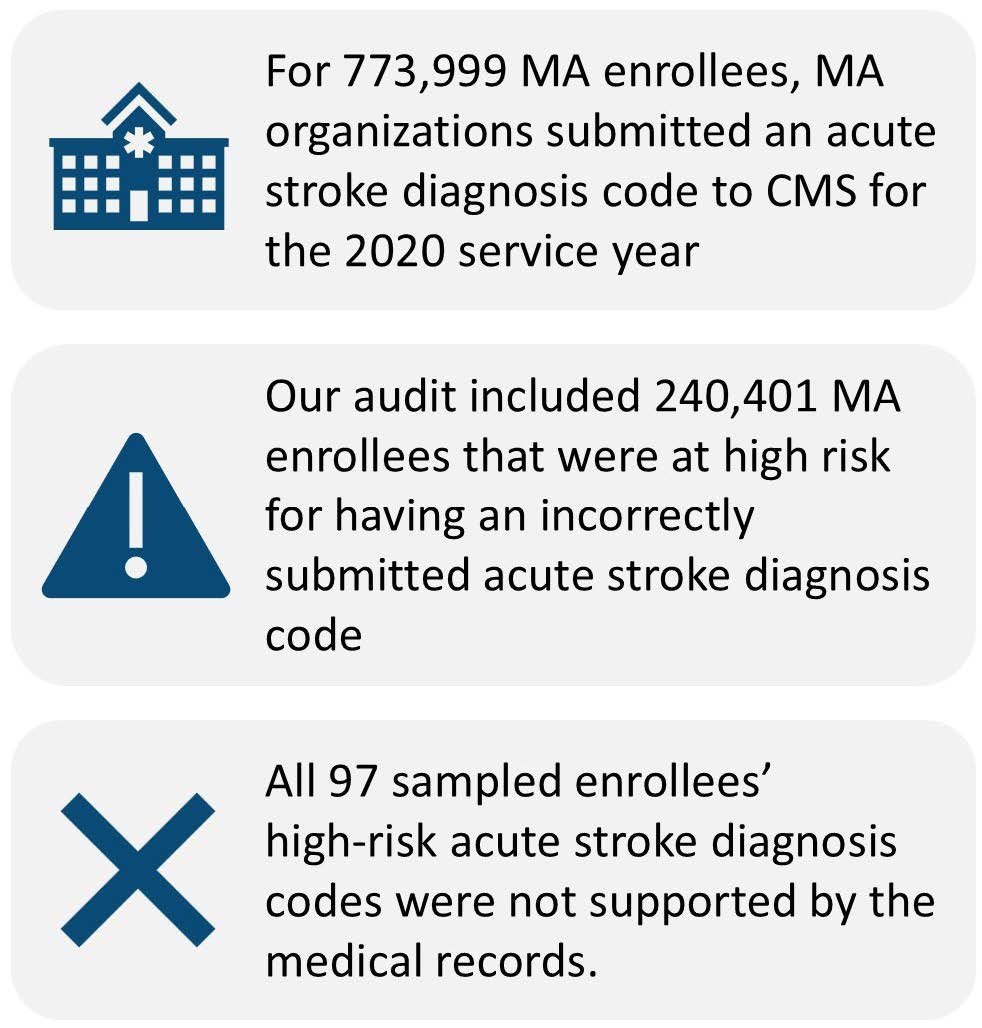
Previous OIG audits of specific MA organizations have identified acute stroke diagnosis codes submitted on physician data records without an acute stroke diagnosis on an inpatient or outpatient hospital data record during the same service year as a high-risk area for overpayment. This audit focused on this high-risk area across multiple MA organizations to examine whether MA organizations’ submissions of these diagnosis codes to CMS complied with Federal requirements. We reviewed MA organizations’ submissions for 97 individuals enrolled in a coordinated care or private fee-for-service MA plan (sampled enrollees).
What OIG Found
- For all 97 sampled enrollees, the high-risk acute stroke diagnosis codes that MA organizations submitted to CMS were not supported by the medical records associated with the physician data records containing the diagnoses.
- On the basis of our sample results, we estimated that CMS made $462 million in potential net overpayments to MA organizations for 2021.
What OIG Recommends
We made one recommendation to CMS to implement a procedure to prevent overpayments to MA organizations when acute stroke diagnosis codes are submitted by MA organizations on a physician data record and the enrollee does not have an acute stroke diagnosis on an inpatient or outpatient hospital data record during the same service year, which could have resulted in cost savings of $462 million. The full recommendation is in the report.
CMS did not specify concurrence or nonconcurrence with our recommendation.
View in Recommendation Tracker
Notice
This report may be subject to section 5274 of the National Defense Authorization Act Fiscal Year 2023, 117 Pub. L. 263.