


Information Blocking
Last Updated: 05-27-2026
On June 27, 2023, HHS-OIG posted its final rule implementing information blocking penalties. The final rule establishes the statutory penalties created by the 21st Century Cures Act. If OIG determines that an individual or entity has committed information blocking, they may be subject up to a $1 million penalty per violation.
The final rule does not impose new information blocking requirements. OIG incorporated regulations published by the Office of the National Coordinator for Health Information Technology (ONC) as the basis for enforcing information blocking penalties. For more information on ONC's information blocking regulations see: Information Blocking.
To report complaints about information blocking, please visit the ONC Information Blocking Portal or the OIG Hotline.
OIG Information Blocking Investigation Process
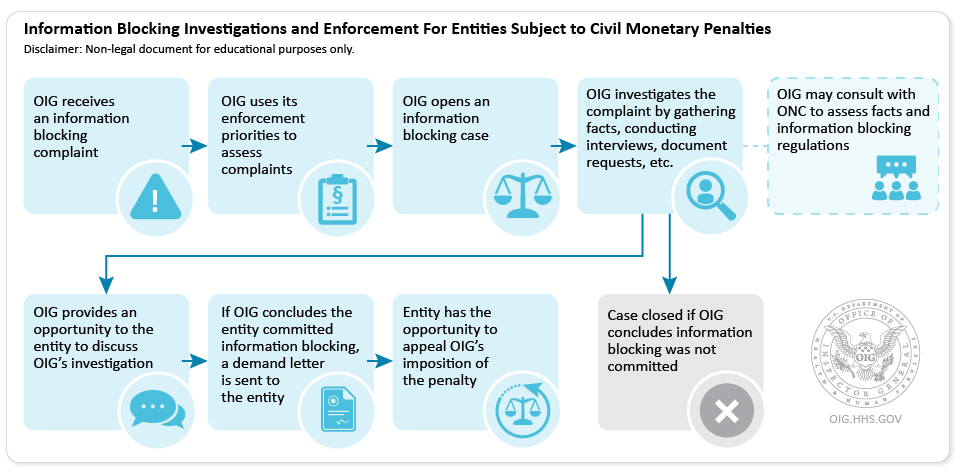
Information Blocking Investigations and Enforcement For Entities Subject to Civil Monetary Penalties
1. OIG receives an information blocking complaint
2. OIG uses its enforcement priorities to assess complaints
3. OIG opens an information blocking case
4. OIG investigates the complaint by gathering facts, conducting interviews, document requests, etc. a. OIG may consult with ONC to assess facts and information blocking regulations b. Case closed if OIG concludes information blocking was not committed
5. OIG provides an opportunity to the entity to discuss OIG’s investigation
6. If OIG concludes the entity committed information blocking, a demand letter is sent to the entity
7. Entity has the opportunity to appeal OIG’s imposition of the penalty
Disclaimer: Non-legal document for educational purposes only
Enforcement Priorities
OIG will use the following priorities to select cases for investigation:
- resulted in, is causing, or had the potential to cause patient harm;
- significantly impacted a provider's ability to care for patients;
- was of long duration;
- caused financial loss to Federal health care programs, or other government or private entities; or
- was performed with actual knowledge.
For more detail on these priorities and OIG's approach to enforcing information blocking penalties, please see the rule.