Compliance 101
The Department of Health and Human Services (HHS) administers Federal funds intended to provide critical services to American Indian and Alaska Native (AI/AN) communities. These funds go to programs in Indian Country including Head Start, Low Income Home Energy Assistance programs, and the Indian Health Service. To ensure these funds are used to provide high-quality services to your community, your organization can create or expand its compliance program.
Compliance is the term used to describe an organization’s responsibility to conform its activities to internal policies and procedures and applicable laws and regulations, including Federal requirements. Complying with such requirements is important for many reasons, but most importantly, it ensures funds are used to provide services that improve the health and well-being of your community.
This course gives an overview of compliance, what it is, why it is important, who is responsible for it, where and when it happens, and how to get started with a compliance program for your organization. If you have not thought about compliance before, now is the time to start!
Course Objectives
By the end of this course, you will be able to:
- explain what compliance is and why it is important,
- identify compliance roles and responsibilities, and
- describe concepts to consider as you get started with a compliance program.
Resources to Help You
In this course, you will find a job aid and helpful resources. If you miss a resource as you go through the training, you can find them all in the last section of the course.
What is Compliance and Why is it Important?
What is Compliance?
Compliance is the term used to describe an organization’s responsibility to conform its activities to internal policies and procedures and applicable laws and regulations—including Federal requirements like Medicare Conditions of Participation and grant terms, rules, and regulations.
Organizations create compliance programs to implement compliance practices such as instituting policies and procedures, and to adhere to internal controls such as reviewing a program’s bank statements. While the fundamental elements of a compliance program are generally the same, the specific components of a compliance program depend on the organization’s size and needs.
Why is Compliance Important?
Compliance is important for many reasons, but most importantly, it ensures funds are used to provide high-quality services to your community. It does this in a several ways. Click on each of the three flip cards below to learn how compliance can help your community and organization.

Compliance helps you better understand who your program serves, how program services are used, and helps you identify opportunities to strengthen program services.

Compliance helps you protect your scarce program dollars from fraud, waste, and abuse to ensure your funds most efficiently support your community.
Compliance helps you avoid mistakes and practices that may cause audit findings, disallowances, and investigations. It is like an insurance policy—you invest a small amount now to protect from having to pay a large amount later.
Who is Responsible for Compliance?
Your organization, HHS agencies, and Office of the Inspector General (OIG) all have a part to play in promoting compliance which ultimately protects program beneficiaries.
Your Organization
Your organization's compliance effort should be led by a compliance professional or another individual who is responsible for the compliance program and is empowered to implement it.
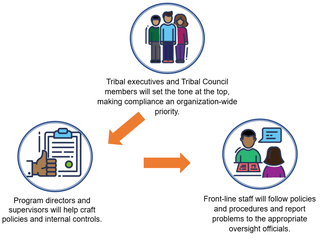
Everyone is responsible for compliance, though their roles will differ by their position and the nature of your organization. Tribal executives, Tribal Councils, program directors, supervisors, and front-line staff all will play a different part. Below are a few examples. While everyone is responsible for compliance, organizations should consider having a Compliance Officer to lead compliance efforts.
HHS Agencies
HHS agencies such as Indian Health Service or the Administration for Children and Families, are also responsible for compliance. Examples include:
- establishing regulations and grant award requirements that further the purpose of the program and promote integrity and accuracy,
- providing consultation and technical assistance,
- conducting post-award monitoring of grantee project or program performance, and
- strengthening organizational capacity to comply with quality-of-care standards.
HHS OIG
HHS OIG is at the forefront of the Nation’s efforts to fight fraud, waste, and abuse in HHS grants, Indian Health Service, and other HHS programs. HHS OIG supports compliance in several ways.
- OIG focuses its work in the AI/AN community to help ensure organizations appropriately use HHS program funds. OIG provides oversight over all HHS Federal health care programs and grant programs serving AI/ANs through audits, evaluations, and investigations.
- OIG identifies risk areas that could lead to waste, fraud, and abuse of HHS funds and risk areas that could threaten beneficiaries’ health and safety. OIG uses its hotline, whistleblowers, data-analytics capacity, and other resources to identify these risks.
- OIG educates organizations on risk areas and compliance. We do this through:
trainings—like this one;
- our audits and other work products that highlight these risks and make recommendations to mitigate them; and
- publications like our advisory opinions, special fraud alerts, special advisories, and more.
4. OIG amplifies this work and provides additional guidance through enforcement. OIG uses its administrative enforcement tools to protect programs and beneficiaries.
Use Compliance to Strengthen Your Organization
Complying with applicable laws and program requirements must inform all decisions regarding the operations of your organization's program, from the time you create your program to when your program achieves its goals and carries on its mission. Everyone within your organization—administrators, financial officers, or service providers and practitioners—must consider compliance.
You have already taken the first step to being able to fully participate in using compliance to strengthen your program by completing this introductory training course. The next step is to continue with this curriculum, while thinking about your program and where there are risks that money could be misused or where beneficiaries are at risk.
On our website, you can find this curriculum, which includes trainings that cover the role of governing boards in providing compliance oversight, and courses that highlight the Seven Fundamentals of Compliance for both grantees and health care providers.
Course Summary
Compliance is the process an organization uses to ensure its activities conform with the organization’s policies and procedures and Federal requirements. Compliance is important for many reasons, but most importantly, it can help prevent fraud, and ensures funds are used to provide high-quality services to your community.
Compliance is a shared responsibility because everyone involved in operating your program—from Tribal leaders to front-line staff—can identify program vulnerabilities. Your organization, HHS awarding agencies, and the OIG all have a part to play in promoting compliance, which ultimately protects program beneficiaries. Compliance should happen at all levels of your organization.
Check out the Compliance 101 job aid below for an easy reference sheet. Make compliance a priority!
Job Aid
Resources to Help You
The document below, Compliance 101 Resources, contains links to additional compliance resources such as our Tips for Implementing an Effective Compliance Program video. These resources may be helpful as you build or improve your compliance program.
Additional Trainings
After you complete this training, consider taking our additional compliance related trainings that can be found on our website. Below are three courses in which you may be interested.
Compliance for Governing Boards: This training focuses on the role of Governing Boards in providing compliance oversight. It describes the four actions OIG recommends Governing Boards take to effectively exercise their oversight responsibilities.
Compliance 201 courses: These two trainings—one for health care providers and one for grantees—go into greater depth than Compliance 101. They focus on the Seven Fundamentals of Compliance; important Federal health care, grants, and contract fraud and abuse laws; and the remedies available to the Government if an entity commits violations.
Job Aid
Knowledge Check
Please take the short knowledge check assessment by clicking the link below. After you answer questions about what you’ve learned, you’ll be asked a few questions that can help us improve this course in the future. After you click submit, you’ll receive your Certificate of Completion. Let’s evaluate your learning!